In case you missed it, this is a continuation of Part I – The Plan.
Now as I move on to the build phase, this will get a bit intense, and there are a lot of photos to show the progress. First I had to deal with the issue of air conditioning, because it is still in Arizona, and hot for most of the year. So in preparation I knew I needed an a/c unit for the office, and the window in that location doesn’t open, so a window a/c unit was out. That left only a few options, so I opted for a small mini-split unit mounted above the window, with the outside equipment sitting on the patio cover over the back porch. The only real thing missing was the electricity to run it. Also given that the existing wall with the ethernet and power backs up to the master toilet, and there was no insulation in that wall, I knew I wanted some sound insulation in that wall. So I made the decision to tear down the drywall on the back wall, and open up the wall.
While the wall was open I hired an electrician to run a new circuit from the break box on the side of the house around the side, and then up into the attic, where it then came through the attic, and down the now opened wall, then out to the outside with a new box on mounted outside the wall, not visible from the inside. I got a cheaper price for having the wall opened up, and I also ended up with a much nicer finished product, with the only part visible on the inside from the work being the mounted a/c unit above the window. While the electrician was here and the wall was open, I also had him take the recessed light already in place, and re-wire it to a new outlet switch I had installed so the office now has it’s own dedicated light, but it used the existing light, we just broke it off the existing string of 4 lights and added it to a new switch. That was the end of the electrical work.
I didn’t really get into taking photos of the process until after the framing was up, which is already a ways into the project, so I’ll try to catch you up to that photo. Following the electrical work, it was then time to commit to the exact location of the walls. I should also mentioned that I decided to use steel studs after much debate with myself due to their apparent improved ability to NOT transfer sound. In the end it was quite the pain, and it was my first time playing with them, which is also part of why I did it. Fun experiment but probably added a lot of extra time to the project learning to work with them.
So my first actual build moment was when I attached the top channel to the ceiling, both of them, doing my absolute best to ensure they were square. Following that, I used a plumb bob [link here] hanging from the outside edge of the channel down to the floor to ensure my floor channel would be exactly straight and level. I then dry-placed the floor channel, and taped the carpet where I would be cutting it so the floor channel would then be attached directly to the sub-floor. Putting the knife to the carpet was another scary moment, but soon enough, the master bedroom carpet was cut, there was no turning back now. Next I installed the floor channel, rolling the office carpet back a bit to allow, with the slight complication of needing to allow the room for the door, so it became some complex measuring and work to ensure the two sides of the doorway were square with each other and in line. Following the channels being put in place, I then quickly put up most of the vertical studs, marking the locations with a sharpie and then screwing them into place with metal-tapping screws [link here]. To ease the doorway attachment, I decided to put some wood studs on the two sides of the door way to attach the door frame to, so I made allowance for those, and crammed them into the channel and attached to a metal stud, as they didn’t go all the way up to the top.

Finally to complete the framing I attached WhisperClips [link here] to the longer, non-door wall along with hat channel to further disperse sound vibrations. Along those lines I also applied sound putty around the ethernet and light and electrical outlets in the open wall to further cut-off any sound from those openings. All of these extra steps took time and money, and more importantly added a TON more complexity to the project, especially in the case of measuring and cutting. Was it worth it, I hope so, as it was definitely a lot of work, but perhaps some of it was overkill, although when the kids come home from school I am still able to work fairly uninterrupted with the door closed. With the metal skeleton now complete, it was time to get to the real work. I should add here that my wife was a trooper with our room being a construction zone with every possible tool and scrap laying all around the room for months. The build timeline from this picture above until I moved my desk into it was a solid 3 months. I had a lot of work travel and other things that interrupted my build time, but it was a fun project to see consistent, albeit somewhat slow, progress on.

The next stage was to add in the sound insulation, which for me meant Roxul Safe’n’Sound insulation that I got from Lowe’s. It was a pain to find the 24″ wide batts, again as I was trying to reduce the amount of structure to transfer sound, I abandoned the standard 16″-on-center studs and went with the 24″ OC. In practice, the insulation shown here has worked wonders, and I can’t hear the toilet flush even if I strain my ear, so that works well. That was doubly helped by my choice to use 5/8″ drywall instead of the standard 1/2″. I won’t say that has been entirely a perfect choice, particularly around the door the extra 1/8″ on both sides made the wall definitely wider than the doorframe, but the heavier mass definitely has helped the sound reduction.


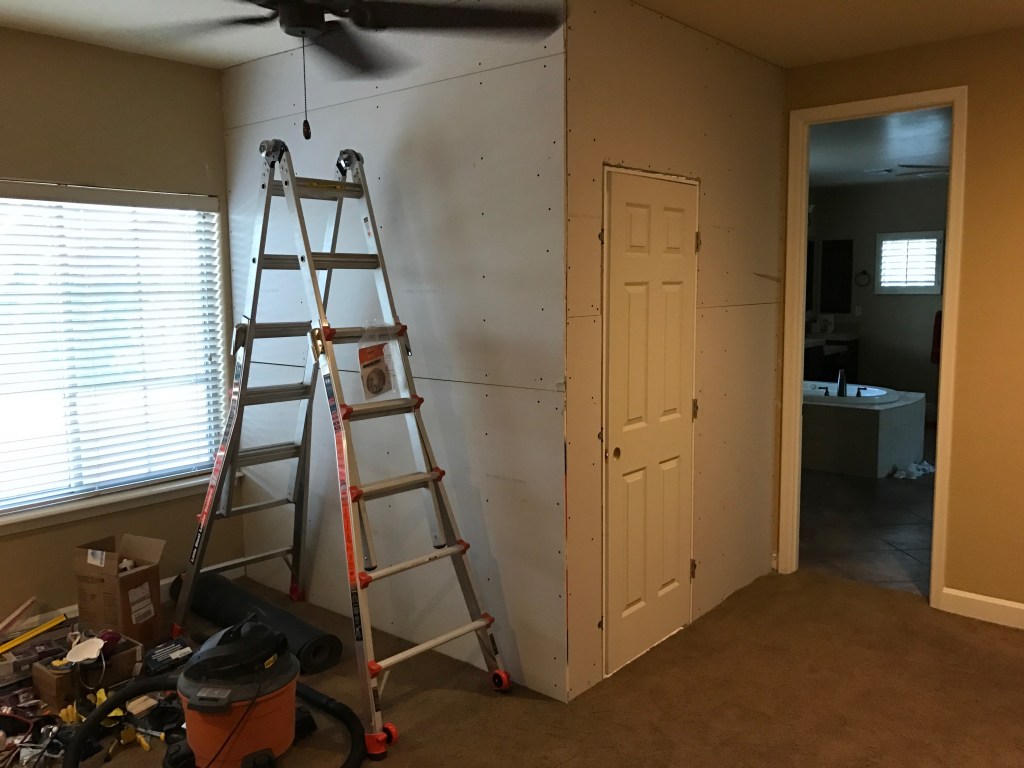
The drywall was a pain, perhaps the worst part of the entire install, as it was heavy and awkward. To make matters worse, the ceiling was VERY far from level, changing 3/4″ over the 7′ length of the office. But it wasn’t a consistent slope, so in several places for the top piece of drywall, I actually had as many as 13 different measurements, every 6-12″ depending on the section, where I would draw out the dimension, and that helped it fit reasonable close to the ceiling.
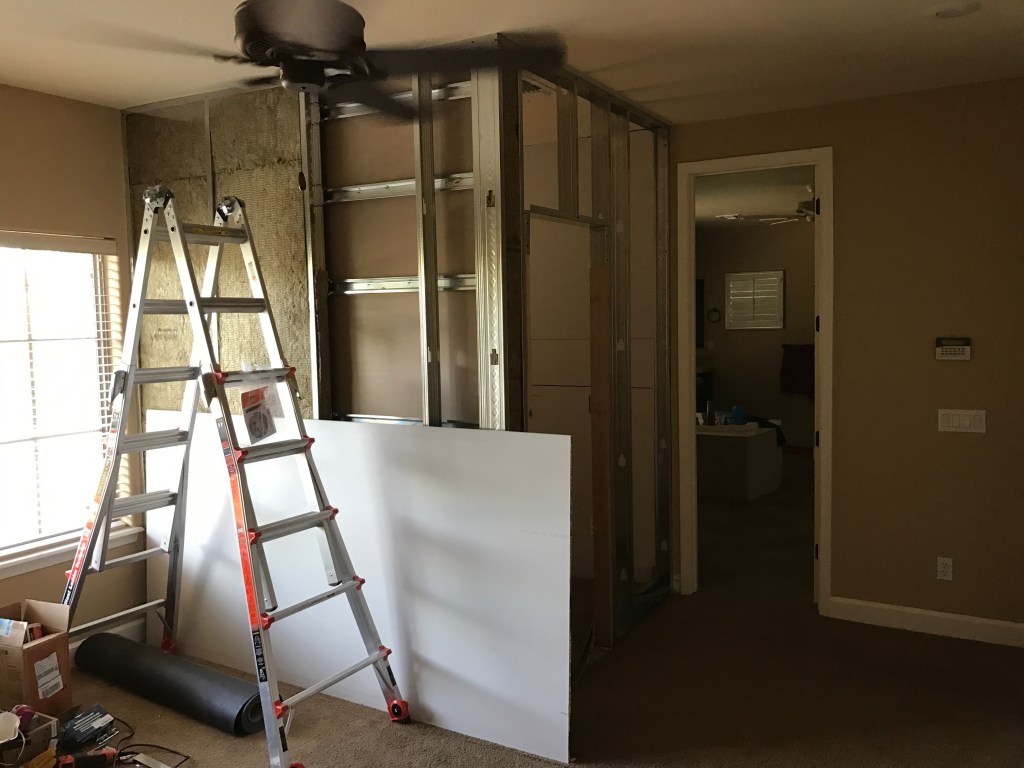

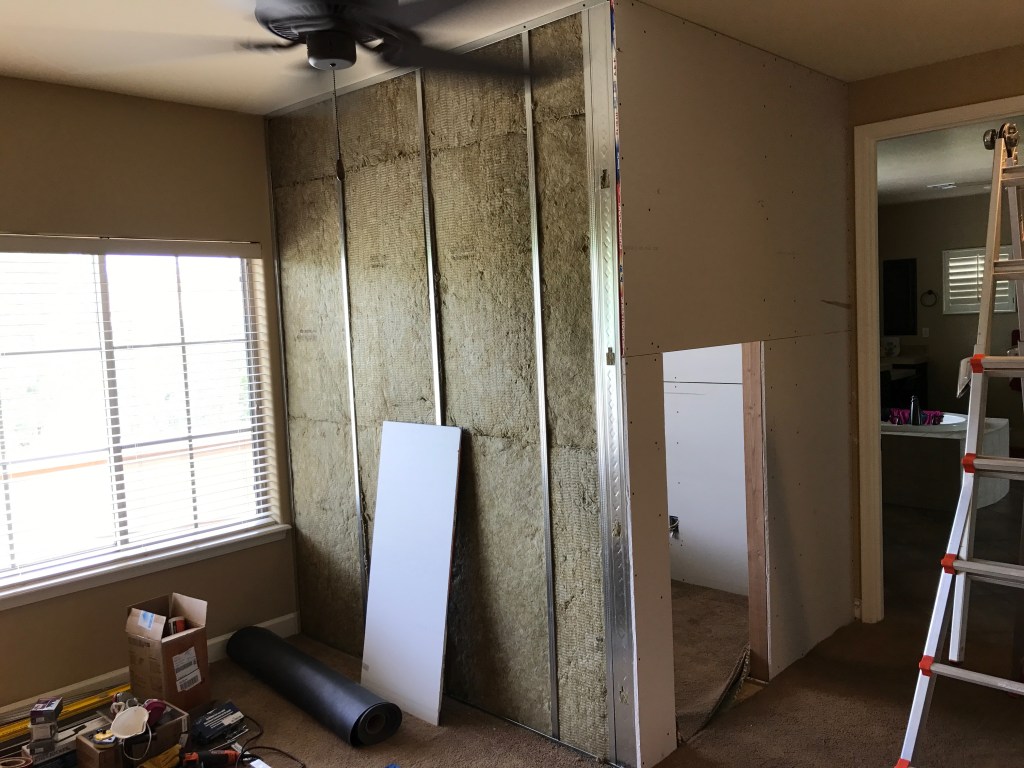

I then went on to installing the insulation in the big outside wall, as well as apply the drywall to the door-side. I first applied the top sheet across the doorway, then later I came back and used my super-star tool from this entire build, my multi-tool [LINK HERE]. This thing seriously saved me probably 50x or more during the process of this build. It is loud and made my hand hurt from all the vibrating, but I couldn’t have finished without this thing, serious MVP! My wife followed right under me with the shop-vac so we didn’t make drywall dust completely cover everything in the room.


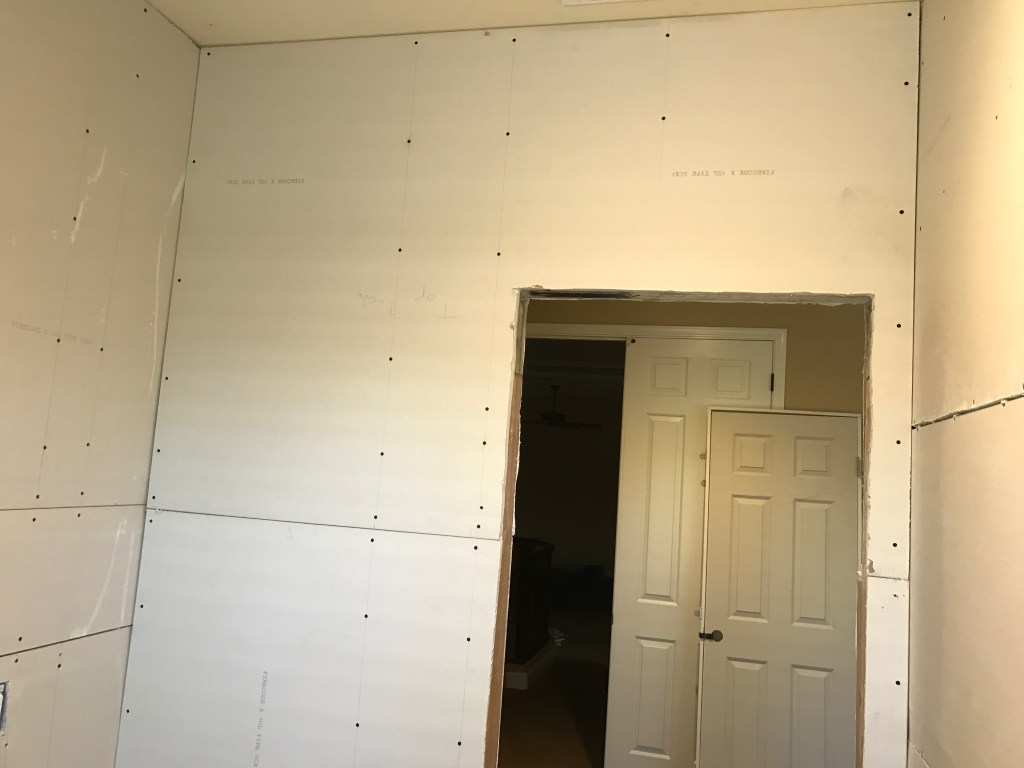
Next up was adding the last bit of insulation into the door wall side of things. I got the insulation estimate just about right, ending with just a little bit extra. Once that insulation was in place, I finished installing the drywall on the outside, and then finally the inside of the door wall. Here I again did the same process, where I installed the full piece, and then went back and cut the doorway open with the multi-tool. At this point the drywall was all installed, and boy was that an achievement!
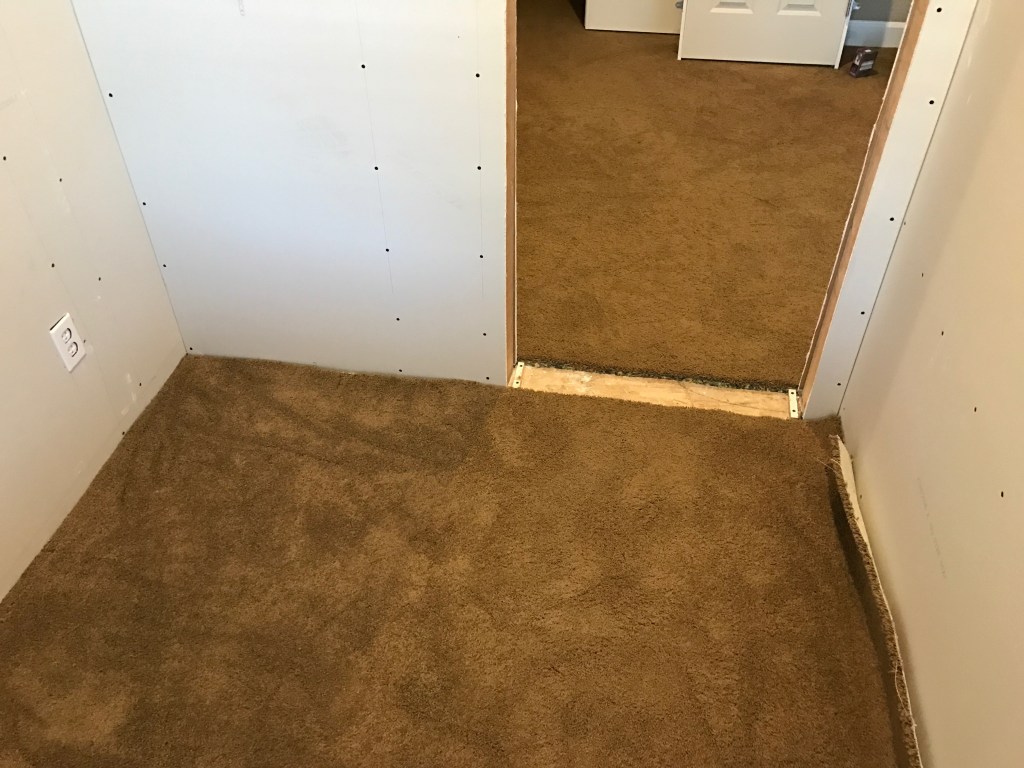
Next it came time to install the door. I had to use some small pieces of trim screwed to the sub-floor to hold the doorframe up a bit to allow enough clearance for the door against the carpet. Again the multi-tool helped get the exact size and such of these small pieces to fit. Since the wood/MDF is so narrow here, I pre-drilled them with a drill bit before trying to put a screw through them so I didn’t split the trim. I used the small brackets to install the doorframe that are supposed to be foolproof. While no easy task, installing the door wasn’t horrible, but never my favorite task, but it does sit pretty level and it was a bit of a tight fit to get it to sit correctly.

See Part III – The Interior Finishing for more of this build.
 Pysan
Pysan 