Continuation from:
May 23 – Installed SolarEdge Power Optimizers and connecting wires
As the next stage of install, it was time to get the SolarEdge Power Optimizers installed. These are installed on the rails directly, one beneath each solar panel. These are used to allow the max solar output from the panels, and get around shade issues and other issues where 1 panel’s output could affect all others in a typical setup. The other benefit of these is that once connected to the panels, they limit the power output to 1-volt until the inverter is actually turned on, so you can test, but hopefully don’t die while interconnecting all the wiring.


May 24 – Zip-tied the wires in place
After the series of optimizers are connected, you then need to ensure that the wires stay off the roof, so I went around zip-tied all of the wires to the rails. It is also worth noting that I broke my 36-panels into 3 series of 12 panels each. 2 of those series are on the West roof, and 1 of the series is on the East roof. A big reason for this is each series needs to hit a certain voltage threshold to the inverter to allow it to start generating power. Since I have panels facing East and West, short of the sun being near high-noon, both sides do not get fully lit up at the same time. My particular inverter could take 3 series so that way I could just run each series home run wires from the panel ends straight to the inverter.
May 24 – Spent all day wrestling 1″ conduit bends
In order to allow all 3 series to come down off the roof with the ground wire, the final segment of conduit was required to be 1″ (which is a beast to bend)! To keep things simple I decided to keep all the conduit as 1″, instead of using smaller sizes in other places, but that choice did make accomplishing these bends much more difficult. All the videos you watch show people bending 1/2″ conduit, and from what I saw it was super easy to do that, the 1″ conduit took all of my weight, and in some cases jumping on it to get it to even budge. Several of my conduit lengths also had some pretty complex bends (6-7 per 10′ length) and my 3D geometry clearly was failing as I scraped probably 10 of the 10′ lengths by getting one bend going the wrong direction, ugh.
My feeling is that the conduit bending was by far the single worst part of the entire project. If I were to do a solar install again, I would highly consider outsourcing this aspect so I just don’t have to stress with it again. The hardest set of bends was the conduit going over the ridge of the roof to connect the West and the East side. There are no online videos to show how to handle that angle, so I ended up building a mini-roof in my garage after 10 times of doing a bend, and going on the roof to try to see how close I was getting. That enabled me to much more quickly iterate my bends until I got it right, and then was able to take it up on the roof and it worked.


May 25 – Ran ground wire
#6 solid copper wire for the ground wire is a bit irksome to work with, but generally this step went fairly well. I left the spool of wire (I bought the 350′ spool from Home Depot, even though I only needed around 150′ as it didn’t come in smaller spools) sitting in the sun for a few hours to allow the wire to soften up as much as possible (but it didn’t end up making that much of a difference). Basically I installed the ground wire lugs into the rail channels, 1 per pair of rails, as the frame of the solar panels connects the pair of rails for grounding purposes (at least for mine it did). I had two sets of ground wires run, one for each side of the roof, that got connected in one of the junction boxes later.
May 25 – 100′ PV wires in West junction box
The next wiring chore was to bring the 100′ PV wires up to the roof, and run them through the junction boxes and conduit. Specifically I began with the West roof (furthest from the inverter) and got the wires fed through the wire nipples into the West junction box, one pair for each series, so a total of 4 PV wires, and my ground wire. I’ll also note that I just used a 6″x6″x6″ Home Depot junction box, where I drilled holes through for the conduit or wire nipples. I then attached it to the rails using a pair of shelf brackets attached with the rail bolts, which I just made up as I went, but it is working great.

May 25 – Wired up between inverter and solar meter
This was a nice short run to wire up. I fished the wire through this short 4′ conduit and then wired up the solar disconnect (left side of pic) to the SolarEdge inverter (right side of pic). You’ll see I kept the inverter behind our wall on the house, so the disconnect is available to SRP (our utility) on the front-side of the house, but the inverter is kept more private behind the wall. This was also my first attempt at a wire pull, be sure to use conduit wire lube which made even this short job MUCH easier (or likely even possible)!
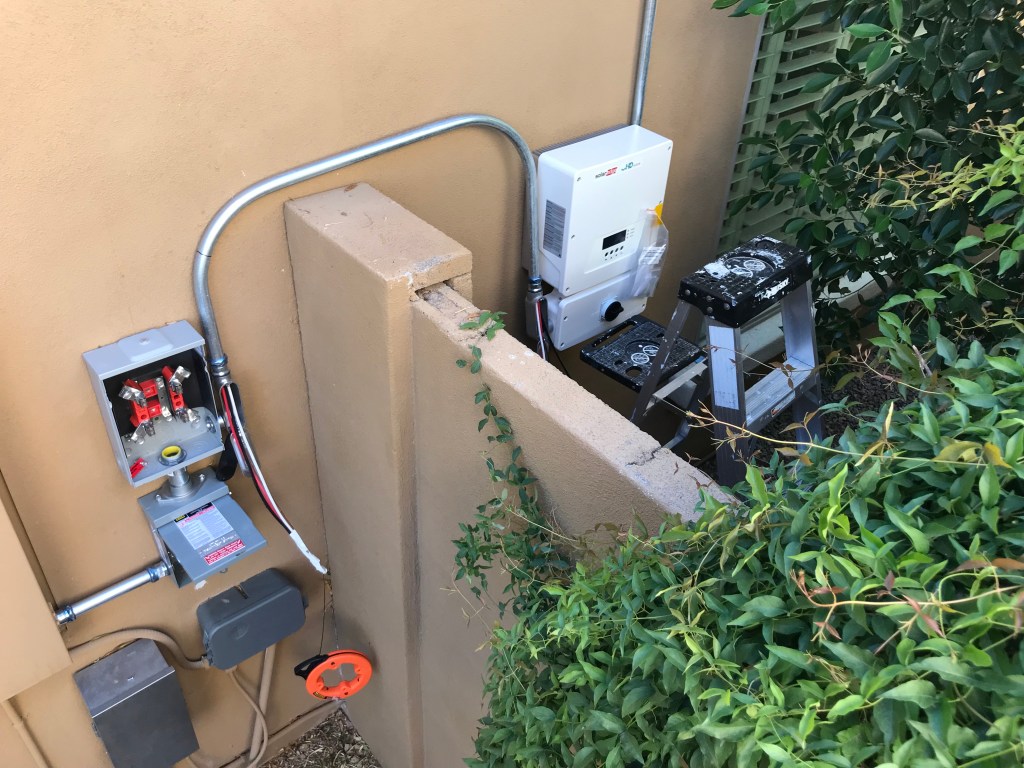
May 25 – Conduit runs completed
Although I showed the pictures above of the fun conduit runs, I didn’t get them all attached until this day. We used special conduit mounts I got at the local electrical supply store (only carrier in AZ) to hold the conduit up from the tile and in place. I also used heavy-duty zip ties to attach them to the bottom of the rails where I could. We got them all connected using water-tight connectors.
May 25 – Accomplished wire pull from West junction to East junction
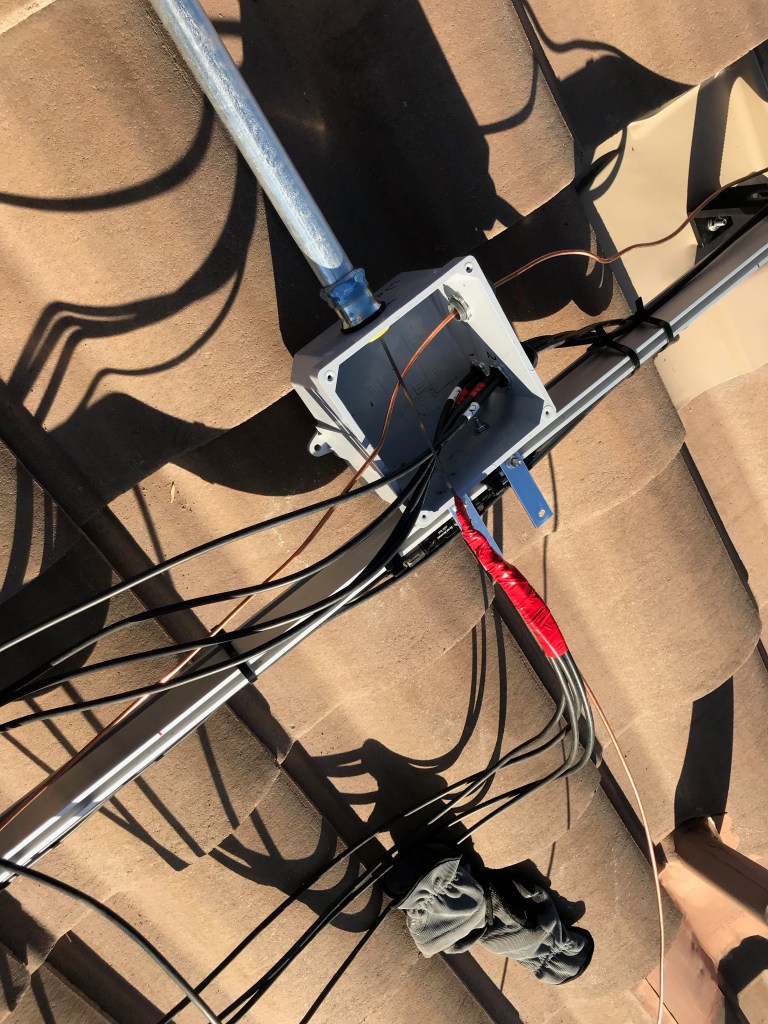
This was a trying wire pull. You can see I have the 4 PV wires from the West roof’s 2 series and the ground wire all taped up into a bundle and attached to my steel fishing tape (the spool end is at the East junction box). I then just put a ton of conduit lube on the wires as they were pulled in periodically every few feet. It was messy, but super easy to clean off and doesn’t hurt the electronics/wiring at all. My wife pulled the fishing tape itself from the East junction box while I did my best to push the bundle through inch-by-inch on the West junction box side. It was slow going, but we did get there. If I had it to do again, I would have had a 3rd person to help keep all the wires waiting to go into the conduit straightened out and organized, as it got a bit messy on my side. But in the end we got them through the conduit and into the East junction box.
I will note that in the East junction box I put a terminal bar for the ground wires, so I then terminated the West ground wire into that terminal bar. The 4 PV wires I left still intact as there was no reason to cut them, splice them, and then pull more wires through the next conduit run, but instead I just continued them through to the next run.
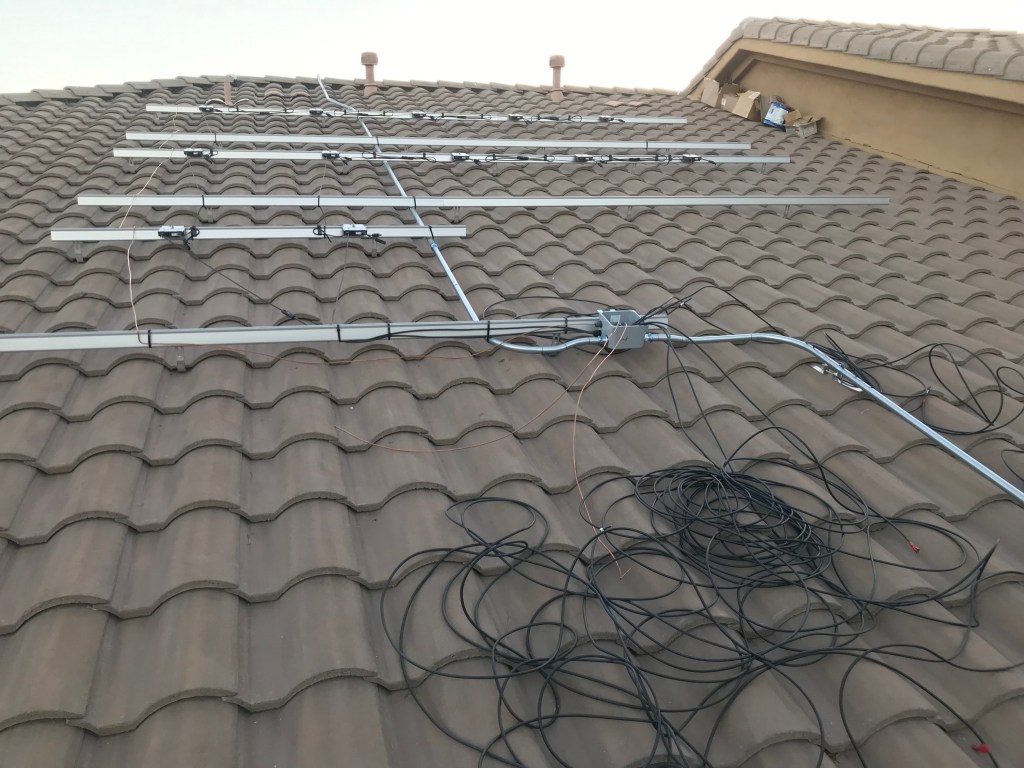
West Junction Box
The only purpose this box has is to be a clean entry point for the 2 series on the West side and the west side ground wire to get into the conduit to make it to the east junction, no connections or splicing take place in this box. Total wires making this trip to the East junction box were 5, 1 x #6 bare solid copper ground wire and 2 PV wires from each of the 2 West roof series.
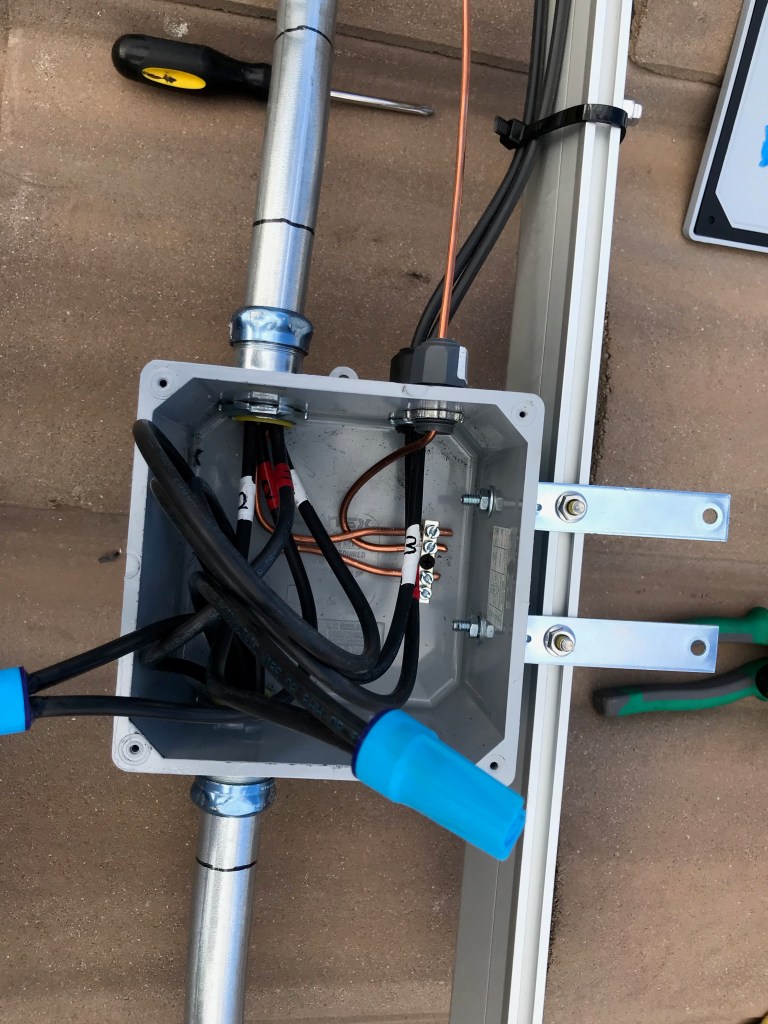
East Junction Box
Here I pass through the west side series cables directly into the conduit leading off the roof to the inverter. I then terminate the west ground wire into a terminal block, along with the east roof ground wire, and the final ground wire making its way off the roof down to the inverter. Due to cutting some of the 100′ wires a bit short, I had to splice 2 of them in this box to add additional length to get off the roof and to the inverter. Total wires going off the roof, 2 wires for each of the 3 series, so total of 6 PV wires and 1 ground #6 bare copper wire, so 7 in total.
May 26 – Sunday – took off for sabbath observance
May 27 – Finished final wire pull from East junction box to inverter
Moving on the the East roof, we first pulled the 2 PV wires (1 series) through wire nipples into the East junction box, along with the East roof ground wire. I then terminated the East ground wire into the terminal block, next to the West roof ground wire. I then attached a new length of ground wire to go through the final conduit pull, from the East junction box down off the roof to the inverter.

As it turned out, I accidentally had cut some of the PV wires from the West roof to be too short to make the final conduit pull, so I had to splice in some longer lengths to allow them to reach the bottom.
Lesson = Don’t cut the 100′ wire lengths until you have them on the ground, I thought I was being clever by not having to pull more wire through that absolutely necessary, and even allowed 5′ “extra” but it turns out it wasn’t extra, haha.
This final pull was the most difficult, as I had the same 1″ conduit, but this time I had 6 PV wires and 1 ground wire to get through the conduit and we had the 90-degree turn off the roof in a smaller conduit junction box to make. So I first pulled from the East junction box to the one hanging slightly off the roof. My wife was pushing the wire bundle in at the East junction box this time, as I was hanging over the edge of the roof pulling the fishing tape and wires through. Once we got the full length of all of that through to that point, we disconnected the bundle from the fishing tape. My wife went to the ground by the inverter and fished the tape back up to me, and then I re-attached the bundle to it, helped guide/force it to make a sharp 90-degree turn, and then we started the feeding process again, this time me pushing it down from the top, and my wife pulling from the bottom. It was especially difficult to get the ground wire to make that turn, but I finally got it with the help of my electrician’s pliers and some serious force. After that I closed up the conduit body’s top, and closed up the East junction box, and got it labeled and stickers installed.
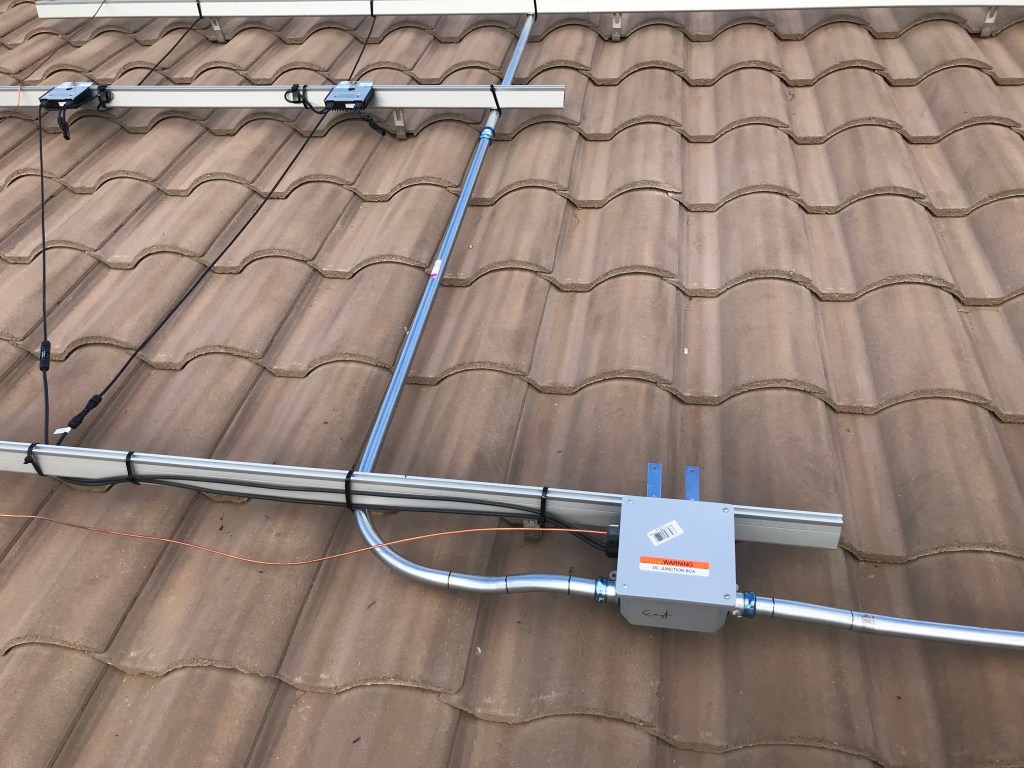
I then got off the roof and spent the evening hours before dark wiring those 7 wires into the inverter. I just barely had enough wire to make it to the inverter of several of the runs, so see the lesson up above :-). With that, all the wiring related to the off was completed.
May 27 – Panels moved to roof and installed
The next and perhaps most exciting, or scary, step was the actually bring the solar panels onto the roof. I had been dreaming up various methods of how we were going to do this, but in the end, we just brute forced them on the roof using 2 ladders. I would hold one side of the panel, and be on the left ladder, and my wife would hold the other side, and be on the left side, and we would just walk up the ladders one step at a time. Then we performed a more complicated dance to get the panel safely and gently onto the roof. Then we both got onto the roof from our ladders, and then we would carry the panel into its position on the roof.
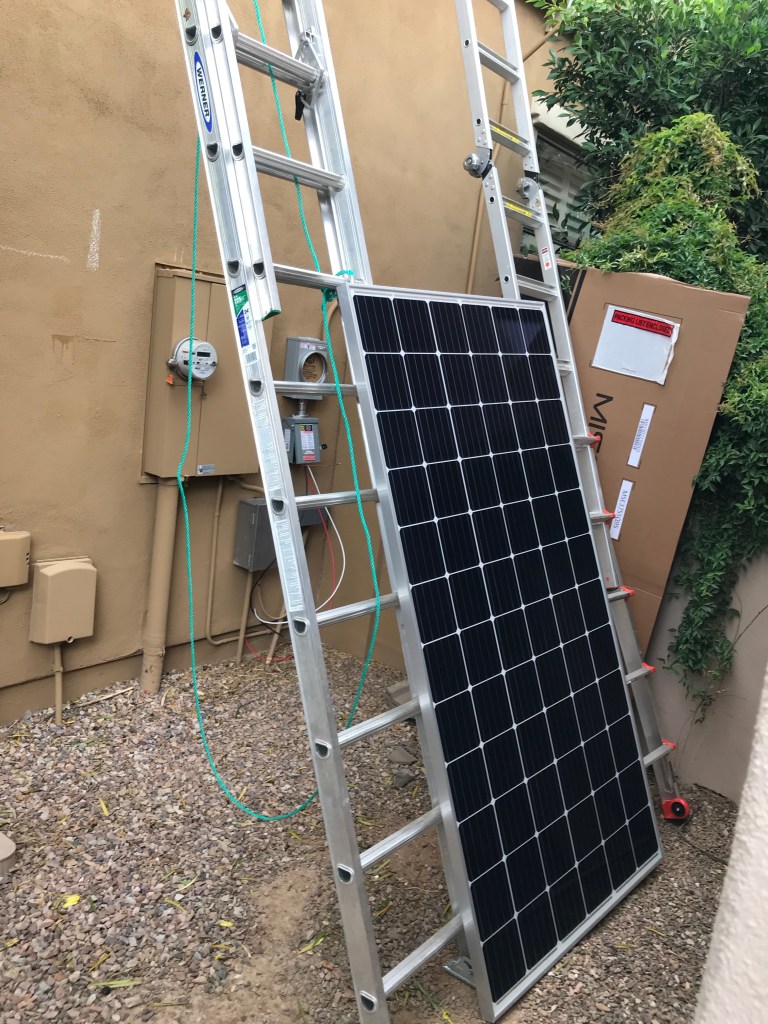
We brought up the first 12 panels and then we stayed on the roof and got those all into their final locations and secured to the rails. I used a drill to do the initial tightening, and then I would finish with a torque wrench to bring it to the final spec’d torque value. We finished up the West roof (being the furthest one to walk to) first and had it all taken care of. This process (once they are on the roof) was super easy. It was a matter of my wife holding up the panel while I snapped the 2 connectors (positive and negative) on the back of the solar panels to the 2 connectors coming from the power optimizers, and they had dummy proof connectors such that the positive could only connect into the positive and vice versa, so like a 5-10 second job. Then we would get the panel into its final spot, and I would secure the 2 bolts on the 1 side to hold it in place, and we would get the next panel in place with 2 more bolts between them sandwiched in place.
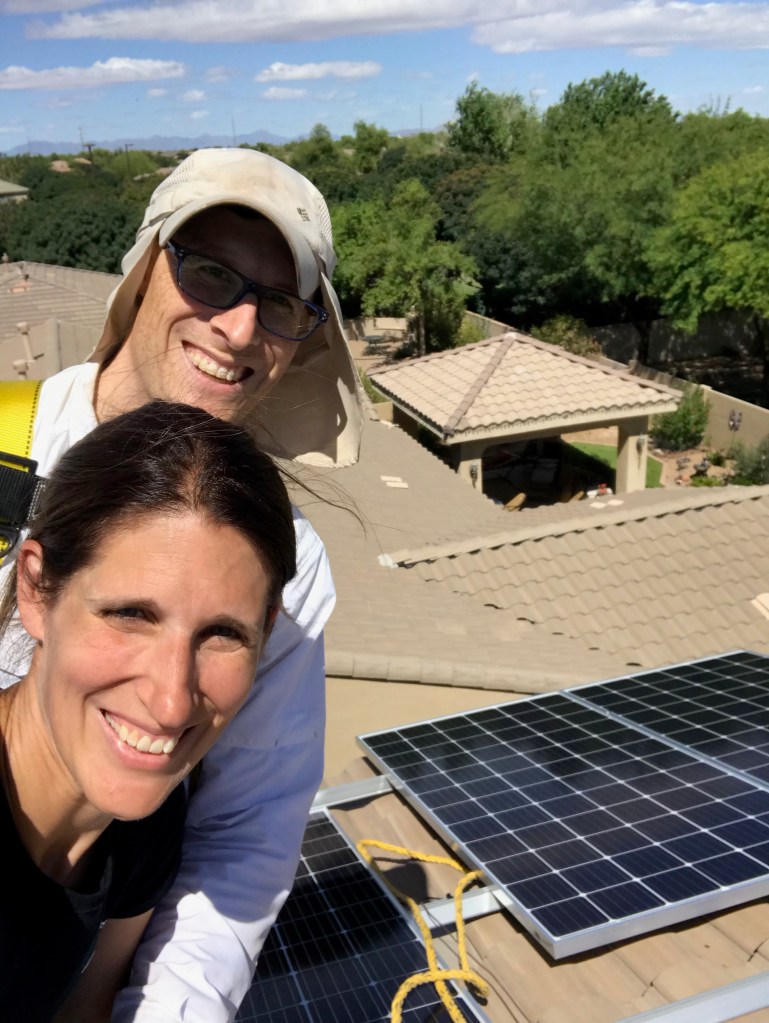

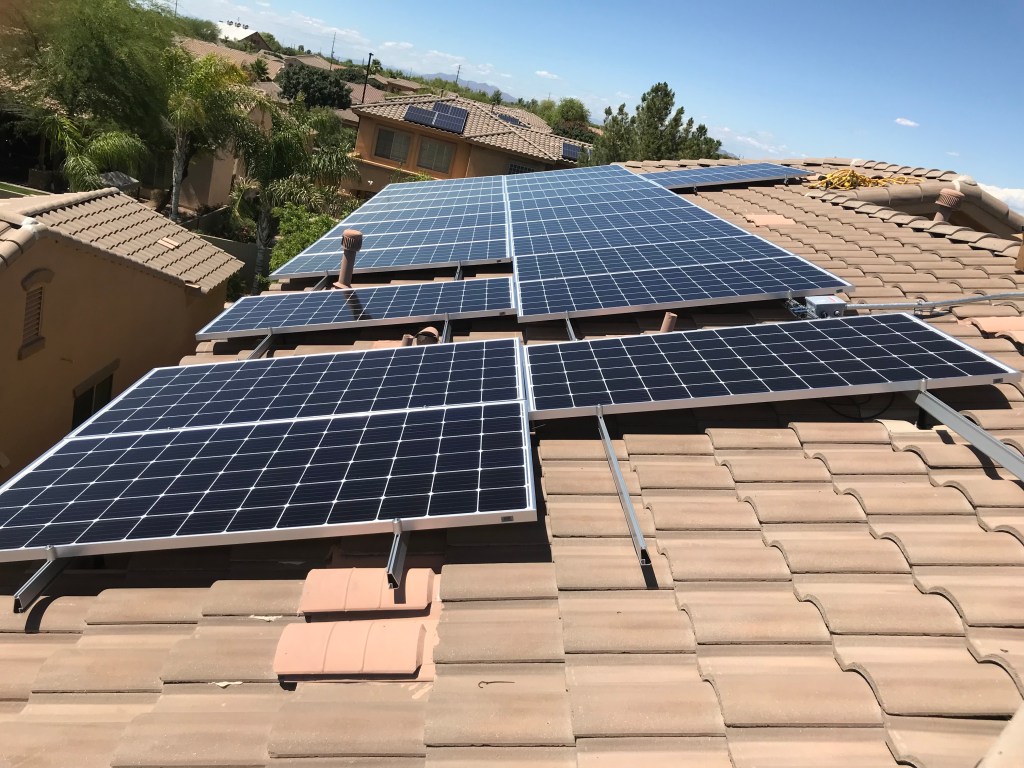
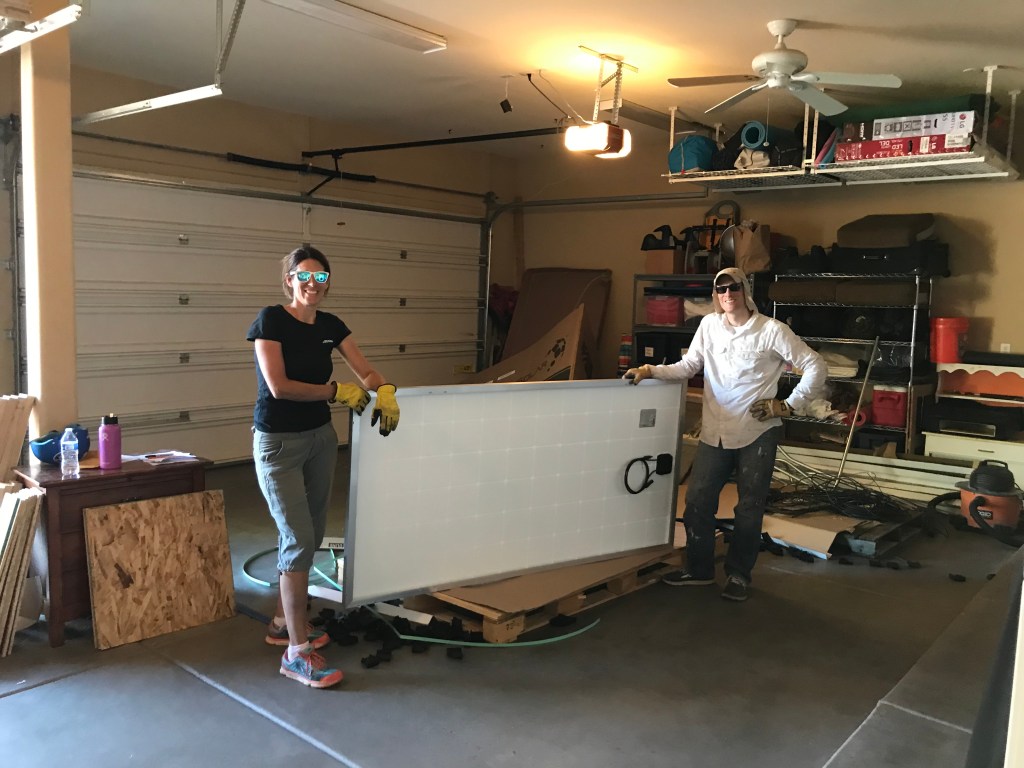
The install process then continued on the East roof and we had at the final panel on the roof by 5:30pm. But as we were going to attach the final few panels, we realized we were short a couple of the end-stoppers that attach to the bolts for the outside edge panels of the rows. So we were stuck until we bought a few more of those. With that, we set the panels in a safe place where the wind and anything else would not dislodge them until the next day (we were not taking them back down off the roof!).
May 27 – Finalized wiring
Being forced from the roof, with nothing more that could be done there I headed to the ground and finalized the wiring between the solar meter box to the solar disconnect and the disconnect to the 60amp 240v breakers in main panel. With that all the wiring was completed, and just waiting until we could get everything else finalized.
May 28 – Finalized East roof panels
Once I got the final two end-caps for the bolts, we then went up and quickly got the last two panels (the bottom two in the pic below) secured in place. That then completed the install of the panels. Now mind you even though they are all installed, and wired to the inverter, you are not allowed to enable the system until the power utility (SRP for us) commissions the system with you.

June 1 – Installed end caps on the rails, and ground off rails to roughly even on sides where overhanging, and then put end-caps on
I went up to finalize the rails, cutting the overhanging areas with my grinder, and then installed the plastic end-caps to keep critters out of the hollow rails. That cleaned up the look as well, and truly meant I was done on the roof. I also installed the last few warning stickers on the solar conduit on the roof and the ground, and got all the plaques attached to the various boxes on the ground with rivets.
June 5 – SRP final inspection and commissioning
While later than I preferred due to SRP (our utility) scheduling issues, we had the inspector arrive at 10:30am. As he looked through the system setup on the ground, he was impressed this was my first install, as well as commenting several times that “this is a very big system” and I told him I know, we wanted it that way. He then checked all of the wiring and when he. got done said it all looked perfect. He then installed the solar meter and replaced the main meter as well with a solar version. With meters in place he and I then began the commissioning process, which took about an hour, with me on the inverter side of the wall, and him on the electrical panel side. We just talked over the wall for the whole hour about what was happening.

We also purchased the Zigbee wireless adapter so we could get the SolarEdge generation reports in the SolarEdge app for keeping tabs on the system. With that the system was up and running, and now we just hope it covers as much of our usage as possible!

 Pysan
Pysan 